
Competition
The World Bank Group’s Digital and AI Vice Presidency is organizing the Small AI for Development Hackathon as part of the Global AI & Digital Summit 2026. The competition invites young innovators aged 18–35 from World Bank member countries to develop practical AI solutions addressing real-world challenges in Agriculture, Health, or Tourism. The focus is on “Small AI”—solutions that are practical, accessible, and designed to work effectively even in environments with limited digital infrastructure or resources. Participants can apply individually or in teams of up to four members. Applications close on 26 September 2026, followed by the online Hackathon on 3–4 October 2026, where participants will develop and submit their solutions. Three winning solutions—one from each challenge area—will have the opportunity to showcase their work at the Global AI & Digital Summit in Seoul, South Korea. Applicants should therefore begin by identifying a genuine problem, understanding the people affected, and developing a focused AI solution that demonstrates clear practical value and potential for impact.
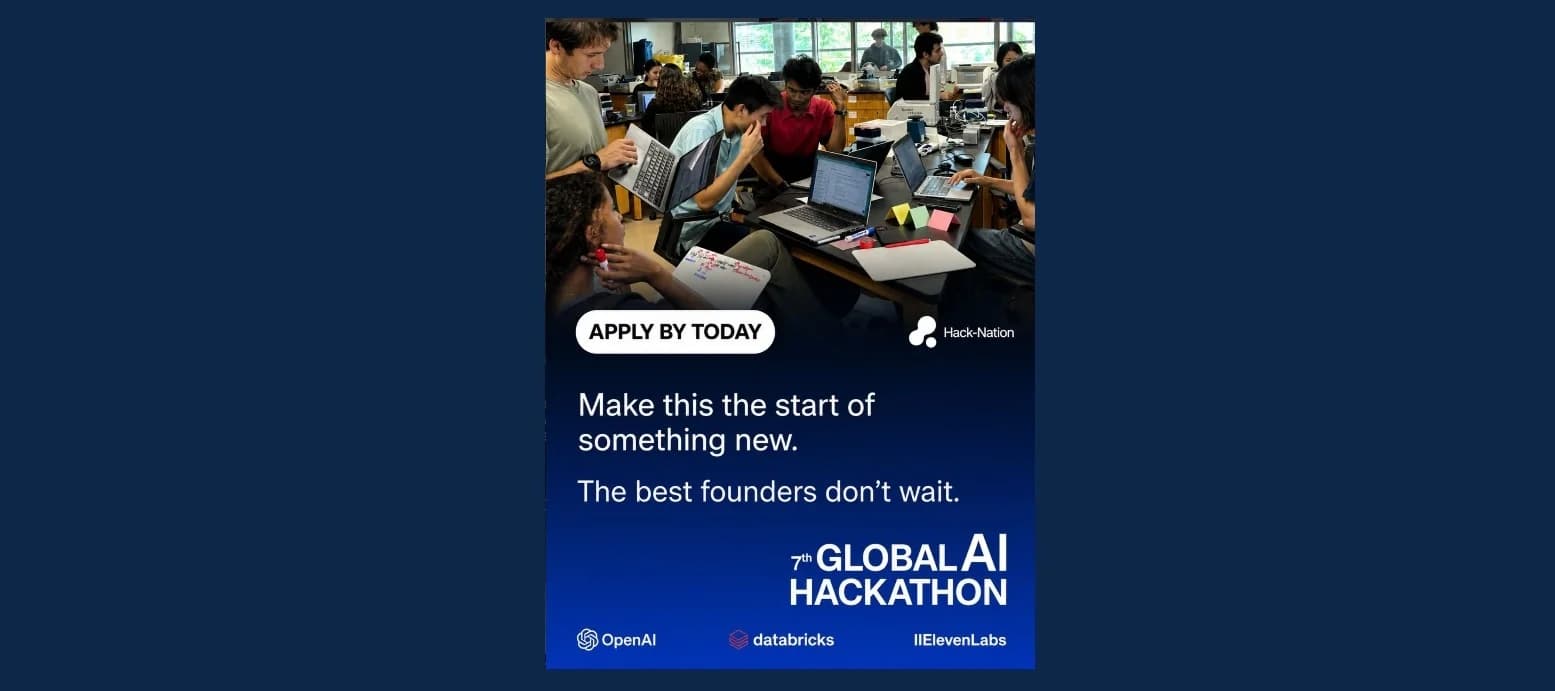
The Small AI for Development Hackathon is a global competition organized by the World Bank Group’s Digital and AI Vice Presidency, in collaboration with the Youth Summit, Development Economics Vice Presidency (DEC), and Information and Technology Solutions (ITS), and managed by Hack-Nation. The Hackathon invites young innovators to spend one weekend developing a working Small AI solution to a real development challenge through a two-day competition taking place 3–4 October 2026.
The competition focuses on three areas: Agriculture, Health, and Tourism. “Small AI” refers to focused, practical AI solutions designed to address specific problems, particularly in contexts where connectivity, computing capacity, or digital infrastructure may be limited. The competition therefore prioritizes relevance, feasibility, inclusivity, and practical impact over technical complexity alone.
The Hackathon is open to eligible young innovators, including students, recent graduates, developers, researchers, and entrepreneurs.
What the competition involves
The competition has two stages.
First, applicants must register for the Hackathon by 26 September 2026. Selected participants will then take part in the online Hackathon on 3–4 October 2026, during which they will develop and submit their solution.
Participants may apply individually or form a team of up to four people. Each team member must register individually and meet the eligibility requirements.
The objective is not to build a large or highly complex AI system. The focus is on “Small AI”: focused, practical solutions designed for real-world environments, including settings where internet access, computing power, digital infrastructure, or access to advanced devices may be limited.
A strong submission should therefore begin with a clearly identified problem and demonstrate how AI can provide a useful, accessible, and scalable solution.
The three challenge areas
Participants must develop their solution around one of three areas:
Agriculture — improving agricultural productivity, access to information, livelihoods, or related challenges.
Health — addressing challenges affecting patients, health workers, healthcare access, or health systems.
Tourism — creating solutions that benefit tourists, local communities, tourism businesses, or the wider tourism ecosystem.
The strongest approach is to identify a specific problem experienced by real people and then determine whether a focused AI solution can address it effectively.
Who can participate
Applicants must generally:
Be 18–35 years old.
Be from a World Bank member country.
Be able to participate in the Hackathon on 3–4 October 2026.
Submit the required application and competition materials in English.
Meet the other requirements specified in the official competition rules.
You do not need to approach this as an attempt to build the most technically sophisticated AI product. The competition places importance on development relevance, inclusivity, design, feasibility, and practical impact.
How to prepare
Although the Hackathon itself takes place in October, applicants should begin preparing now.
A useful starting process is:
1. Select one challenge area.
Choose Agriculture, Health, or Tourism based on where you understand a real problem.
2. Define one specific problem.
Avoid starting with an AI technology. Start with a problem faced by a particular group of people.
3. Understand the users.
Consider who experiences the problem, what they currently do, and why existing solutions are insufficient.
4. Design a focused AI solution.
Think about how AI can solve a meaningful part of the problem, particularly in environments with limited resources or connectivity.
5. Build and test a prototype.
Your aim should be to demonstrate that the idea works and can create measurable value.
6. Prepare to explain the impact.
Be ready to show why the solution matters, who benefits from it, how it can be used in practice, and how it could eventually be scaled.
What is at stake
There will be three winning solutions, one from each challenge area: Agriculture, Health, and Tourism.
The winning teams will have the opportunity to showcase their solutions at the Global AI & Digital Summit 2026 in Seoul, South Korea, before an international audience that includes representatives from governments, development organizations, businesses, investors, and technology communities.
For a young innovator, this makes the competition more than a conventional hackathon: it is an opportunity to develop a solution around a real development problem and present that work on an international platform.
Key dates
26 September 2026 — Application deadline
3–4 October 2026 — Hackathon
5–6 October 2026 — Winners notified
By 18 October 2026 — Winners travel to Seoul
21 October 2026 — Solutions showcased at the Global AI & Digital Summit
How to apply
Applications must be submitted through the official Hack-Nation application process. The official World Bank page provides the application link, eligibility requirements, competition rules, challenge information, and other details.
Official information:
World Bank - Global AI and Digital Summit: